| From
the Desk of Richard S. Lowry |
A Chat with David Petraeus
March 29, 2007
Richard S. Lowry
There has been a dramatic change in Americas
strategy in Iraq. The new priority has become security of the people
of Baghdad. Americas fortress mentality is gone and there
is a whole new feeling of partnership in the Multi-National Force-Iraq.
While the situation in Iraq remains dire, we have
finally adopted a strategy that has a chance of returning sanity
to the people of Baghdad. It is still too early to determine if
Fardh al-Qanoon (enforcing the law) will work. All the odds are
against General David Petraeus, but if anyone can bring peace and
stability to Iraq, it is he.
We are involved in a worldwide conflict and the
front lines are in Iraq. We are involved in a conflict our military
was not prepared to fight in 2003. We are involved in a modern-day
counterinsurgent war a netwar. General Petraeus knows the
seriousness of this assault on the free world and he knows how to
win against these 21st Century insurgents. Before taking command
of the Multi-National Force, he was the Commanding General of the
101st Airborne Division; the commander of the Multi-National Security
Transition command where he helped build the new Iraqi Army; and
most recently the commanding general at the U.S. Army Combined Arms
Center at Fort Leavenworth, where he oversaw the revamping of the
Counterinsurgency Field Manual FM3-24.
Last Thursday, I had the privilege of speaking with
him on the telephone. We started by talking about the Iraqi people.
The General spent several minutes talking of the sheer horror Iraqis
have suffered most of their lives. They have lived through the Iran-Iraq
war, Desert Storm, a decade of sanctions and the Invasion of 2003.
Then, instead of freedom, they have suffered through the chaos of
the last several years.
He said, that they have endured serious, brutal,
horrific, barbaric terrorism carried out by Al-Qaeda only
to be followed by senseless sectarian violence. The general went
on to say that the, various sectarian militia, shia militia,
got way out of control. [They] hijacked governmental ministries
and certain security force elements
particular[ly] in the wake
of the violence following the Askari Mosque bombing in late Feb
of 2006. The bombing stoked sectarian violence on both sides.
General Petraeus voiced empathy for the people. He said, They
have endured a lot. They are a resilient people; its a nation
of survivors. Its a nation of people that in many respects
have endured enormous oppression. The combination of oppression
and sectarian violence has taken a toll on the Iraqi society.
Petraeus continued. With a lot of those that
had an option overseas leaving, Iraq has suffered a brain drain
of varying proportions. A lot of the Technocrats just couldnt
hang in there. With the people who administered Iraq on a
day-to-day basis no longer sitting behind the desks in government,
You have people governing who, by in large, have had little
experience in running large organizations [or] strategic level institutions.
There are just an awful lot of challenges.
Petraeus said.
GOOD NEWS
Petraeus continued with his assessment. You
have to then say that every place in the country is different and
that there are certainly nine provinces in the south that are relatively
calm. Certainly there are challenges in various places at various
times but they are ones that the Iraqis generally can solve if they
have too. And, then of course there are the three Kurdish provinces
that are very calm [and are] relatively progressive in the sense
of free market economics within a still somewhat central governmentally
run economy, but there is a lot of private investment.
I interrupted with the comment that there seemed
to be a large number of disparate groups all competing for their
own piece of the pie. General Petraeus agreed. Its a
big competition right now among a variety of groups; and, again
in an environment, in Baghdad in particular, [that is] very heavily
colored by an influence of the sectarian violence. Neighborhoods
have been depopulated and General Petraeus believes that hundreds
of thousands, maybe millions of Iraqis have been displaced.
Most damaging of all, General Petraeus
contends that the situation has reinforced suspicions or created
suspicions where there werent any between Sunni and Shia in
a country in which there is a fair amount intermarriage between
the sects in the past and where sectarian violence was not a huge
issue, perhaps partly because Saddam ruled with an iron hand and
put down the Shia all the time.
I moved on to ask him about the current plan to
secure Baghdad and he proudly pointed out that the Clear and
Hold strategy has already been used with good effect in Mosul
in 2004 and TalAfar in 2005. What General Petraeus modestly
forgot to mention was that it was he who adopted the counterinsurgent
strategy in Mosul when he was commanding the 101st Airborne and
Colonel H.R. McMaster who architected the TalAfar success.
(Colonel McMaster is now a trusted advisor to General Petraeus.)
The general was quick to point out that If youre going
to secure the population, if thats job one, then you have
to live with the population you are going to secure.
He then reflected on the past strategy. For
a variety of reasons, some pretty good reasons, we were gradually
consolidating in larger bases and handing off to the Iraqis. The
transition to Iraqi Security Forces, Iraqi control and local control
was emphasized heavily. That was sort of moving along reasonably
well until it was really undone by the bombing of that mosque and
the resulting sectarian violence.
Al Qaeda in Iraq had been dealt a crushing defeat
in the second battle of Fallujah. Without a dramatic event to ignite
sectarian violence, the insurgency could have failed. Abu Musab
al-Sargawi and his henchmen plotted an attack so heinous that every
Shia in Iraq would be rallied to violence against the Sunni minority
who had dominated the country for generations. The bombing ignited
sectarian violence and derailed American plans for transition to
Iraqi control.
THE WILD WEST
Then there is Al Anbar province, an area which not
long ago a Marine Colonel described as a cross between the Wild
West and Mad Max. But, now the people of Anbar Province have finally
had enough of Al-Qaeda and the violence and chaos they have brought
to their homes. Tribal leaders are working with the Multi-National
Forces to rid the area of these foreign fighters and military-age
men are swarming into towns to join the Iraqi Police force. General
Petraeus agrees that for the moment, things are going well in Al
Anbar. In Anbar Province an encouraging development is the
rise of Sheiks and tribes who want to fight against Al-Qaeda and
to secure their own areas to contribute to the Iraqi Security Forces,
in particular in there own areas.
I commented to the general that I thought that Nouri
al-Malikis visit to Ramadi was very significant. He agreed.
That was a very important visit. That was of strategic significance.
[That was] the first time he had been in Ramadi since the 1970s.
BIG DEAL! That area continues to progress. Interesting, what you
dont have there is sectarian violence. What you have there
is Al-Qaeda and other insurgent elements that want to return Saddam,
create a caliphate [or] do any number of different things.
BAGHDAD
Then there is Baghdad. Baghdad has become the primary
battleground in Iraq. Baghdad, a city the size of Los Angeles,
is spread out and very diverse. What you have there is almost a
tale of two cities to some degree. It is a tale of one city that
is predominantly Shia, those areas in which security is pretty good.
AlQaeda is trying to get in and blow them up periodically
but the checkpoints are stopping a good bit of that. Where commerce
has returned, the markets have reopened. We have hardened all the
markets. And Im talking about enormous markets that have tens
of thousands of people. Those areas have bounced back very, very
well.
Then you have the mixed areas though that
are still in the sense battlegrounds
All it takes is one death
squad just to really literally ruin the neighborhood. They are fault
line neighborhoods or they are Sunni Arab neighborhoods that are
under threat from both Al-Qaeda, whos trying to retain them
as logistical routes or safe havens, and by, in some cases, Shia
extremists who are trying to expand into those areas or to push
into another block or another neighborhood.
Those are challenging places and they are
challenging for the people that live in them as well
In fact
we were in one of them just yesterday the Amariyah area of
Baghdad which is just east of the Baghdad International Airport;
between that and the wealthy Mansur area, where all the diplomats
used to live. And we were out talking to folks in the market and
on the street and all that stuff. They are surviving, they are enduring.
But you know its a pretty tough existence for them, frankly.
THE KEY TO SUCCESS
We are only a few weeks into the Baghdad Security
plan. Only two of the five surge Brigades have been inserted into
the city, yet General Petraeus is cautiously optimistic. He knows
what it will take to win. The truth is, the key to all of
this is the Iraqi leadership and we should make no mistake about
it. The Iraqi Army will do well if it has good national leadership,
like any Army. If the national leadership cannot not hang together
as a national body, then how can you expect the national army to
remain together?
You have to have a national government. You
have to have national direction. I think the army is one of the
better stories. It is a mixed bag in some cases but, by in large,
the army has some quite good units, quite heartening units. I was
just up in Ninewa Province for example and there are two pretty
good Iraqi Army Divisions up there. In fact, we have only a single
battalion contributing to the security in Mosul, in large measure
because there is a pretty good Iraqi Army Division, pretty good
police chief and police force. It is not perfect. Its under
threat. Al-Qaeda is trying to open a new front there. They did manage
to break guys out of a prison. There are all kinds of pressures
and challenges. But thats actually a place where you can see
the future of a smaller coalition presence and Iraqis stepping up
to the plate and taking over. I wouldnt say its easy there
because you have some real ethnic challenges between Sunni Arabs
and Sunni Kurds.
Iraq is rife with problems and challenges. Each
area seems to have its own set of unique issues. This is what makes
victory in Iraq so difficult. But when asked, General
Petraeus said this: The real challenge is to create something
that is sustainable. We could cut a deal with the Mahdi Army, for
example. We could bargain for six or nine months of peace with them
but that serves no purpose.
FOCUSED ON THE JOB IN IRAQ
Hopefully, we can create a window for opportunity
for the Iraqi leaders so that they can bridge some of the differences
[and] achieve true national reconciliation. And if they cant,
then we gotta look each other in the eye and say it's not gonna
happen and say we need a Plan B.
When I asked the general about the current political
situation in America, he made it quite clear that his job was to
remain focused on the mission in Iraq. Then he went on to say: I
think that a soldier should understand the mission he has been given
and make sure he and his boss have discussed it and they are both
clear on it and then ask for what he needs and then do the best
he can with what he gets. And, inform people of the risk if he doesnt
get what he asks for. And, if its sufficiently less than what
is judged to be needed, then he has to go back and say I cant
accomplish the mission, lets change the mission. Thats the
approach you have to take.
I cannot make my recommendations based on
what I think the pain is back there for the military services or
the White House or Capitol Hill or anything else. All we can do
is do our mission to the best of our ability and retain integrity
as we do that. And, be willing to note that if its not going
to happen. Ive gotta say that. I owe that to 150,000 young
Americans and anther 10,000 coalition partners.
General Petraeus believes that the mission is doable,
but he cautioned, It is by no means a done deal. There
are no guarantees. My job is to help the Iraqis establish
a better level of security in Iraq that is job one.
____________________________________________________________________________________________________________________________________________________________________________
Give Peace a Chance
Richard S. Lowry
3/11/07
Daily, we hear pundits in the government and the
media call for America's withdrawal from Iraq. They claim that the
country is spiraling into civil war and that the violence unnecessarily
continues to take American lives. They claim that the Iraqis are
not stepping up to the plate to secure their own blessing of liberty.
And, they bristle that last November's elections prove that the
American people have had enough.
Democratic presidential candidates claim that President Bush is
unresponsive, yet they have not come up with any plan other than
setting a date to remove our troops or threats of withdrawing funds
for Iraq.
Late last year, the President realized that a change of course was
necessary in Iraq. He read and considered the recommendations of
the Iraq Study Group. He also asked the Chairman of the Joint Chiefs
to produce a new plan for success in Iraq. After significant consideration
of many views, President Bush decided to act. Donald Rumsfeld was
replaced, as well as all the top commanders in Iraq.
"New blood" was brought in and a dramatically new strategy
was adopted. General David Petraeus was given command of the Multi-National
Force Iraq and he brought in a brain trust of battle-tested commanders
to sit on his staff.
Petraeus, former commanding general of the 101st Airborne Division
and author of the newly-released field manual on Counterinsurgency
(FM3-24), holds a PhD in International Affairs from Princeton University.
His commanders and advisors include Lieutenant General Ray Odierno,
Major General Joseph Fil Jr (current commanding general of the 1st
Cavalry Division), Brigadier General Joseph Anderson and Colonel
H.R. McMaster (Desert Storm Hero and world-renowned author of "Dereliction
of Duty"). These men will be running the American show in Baghdad
over the coming months.
More importantly, the Iraqis themselves will be running the security
operation in Baghdad, led by Lieutenant General Abbud Gambar. Gambar
is a former Iraqi Army General who served under Saddam Hussein and
is one of the few Shiites who managed to rise to a position of power
in the Iraqi Army. He is a capable man and he is dedicated to the
new Iraq. A Middle Eastern author recently said he is the right
man in the right place at the right time. You will all hear much
more about General Gambar in the coming years.
With little more than a month under his belt, General Petraeus gave
a press conference last week. The media highlighted only a few sound
bites. They needed to televise the entire news conference. General
Petraeus did a great job of describing the current situation and
his overall plan to bring peace and prosperity to the people of
Baghdad. Take a few minutes and read the entire manuscript of his
press conference.
http://www.mnf-iraq.com/index.php?option=com_content&task=view&id=10475&Itemid=128
General Petraeus has adopted a completely new strategy to win in
Iraq. He wants to implement a counterinsurgency war. You will find
that military operations will only be a small component of his plan.
He wants to establish security so Iraqi children can go to school
and their parents can work to support their families, in peace.
To do this, the Multi-National Force-Iraq will move in and clear
neighborhoods and then stay. They will establish 32 Local Security
Stations throughout the City. These neighborhood police stations
will be manned by American and Iraqi Army troops, as well as Iraqi
Police - 24/7. Once a modicum of security has been established,
the Iraqi government is going to move in and conduct SWET operations,
with the help of the American forces.

1 - American Soldier on patrol in Baghdad - 2/26/07
SWET stands for Sewers, Water, Electricity and Trash
Collection. In addition, the Iraqi government is preparing to pour
megabucks into local construction projects. The "Surge"
is much more than a military plan to kill all the bad guys.
According to modern counterinsurgent doctrine, our forces will not
go looking for a fight (they will defend themselves and they will
defeat insurgent attacks) but their primary goal will be to bring
peace and prosperity to the people of Baghdad. In my opinion, the
security forces WILL NOT go after Sadr. They will work to marginalize
his position and show the people of Baghdad that Sadr's methods
will only bring more violence and unrest.
What do you think the new plan's end-state will be? If the plan
succeeds, Iraqi police will be established in all the neighborhoods
of Baghdad. They will be trained so that they can maintain the peace
and American forces can leave. General Petraeus is working to make
Iraq a better place for the Iraqis. We all need to give him our
support. Let's all hope and pray for his success in Iraq. It will
save American and Iraqi lives. And, a peaceful Iraq will naturally
lead to our troops coming home.
Yet Hillary recently announced that she is going to vote for the
democrat proposal to bring troops home by the end of the year. I
propose that she and her colleagues' positioning for the 2008 elections
will become totally irrelevant in the next several months when General
Petraeus's plan works.
There are many indications that the conditions in Iraq are already
improving. This is a new day in Iraq and I believe we are finally
on the right track toward peace and stability in that war-torn country.
I think that is what we all want.
Don't take my word for it. Just sit back and watch what is about
to unfold. In one short month since Petraeus took over, murders
and bombings have drastically decreased, American casualties have
decreased dramatically, a regional conference of 200 diplomats has
been held in Baghdad, hundreds of insurgents have been detained,
dozens of weapons caches have been uncovered removing the explosives
for hundreds of IEDs from the hands of those who would use them
and the people of Baghdad are inviting American foot soldiers in
for tea.
Another encouraging development is that the multi-national force
uncovered two bomb making facilities which had stockpiles of chemicals
for mixing explosives. This is encouraging in that it shows that
the enemy is running out of military-grade explosive devices. They
are being forced to "roll their own" IEDs.
And, Operation Fard al-Qanum is just starting.
I realize that we have all been through four years of frustration
in Iraq. I realize that many Americans believe that this war was
unnecessary, or worse. For better or worse, we are there and we
have an obligation to leave the people of Iraq with a government
that can keep the peace. It has been a long hard road getting the
Iraqi Army and Iraqi Police back on their feet. They are nearly
ready to take over and they are certainly willing to fight to make
Iraq a better place for their families.
Give peace in Iraq one last chance.
_____________________________________________________________________________________________________________________________________________________________________________
World War Three
Richard S. Lowry
7/12/06
We are living in turbulent times, but you would never know it walking
the streets of America. America has been at war, or should I say
that America's enemies have been at war, since the taking of the
U.S. Embassy in Tehran. The World has been involved in this slow-motion
war since 1979. Yet, the everyday American does not feel the effects
of this conflict. We all live in such comfort and security that
we do not realize that our "Camelot" is under siege.
In years gone by, when aggressors attacked their
enemy, it was quite clear to everyone taking refuge in the castle
that a state of war existed. Everyone knew that they were in peril.
Today, we are fighting a war halfway around the World. Surely, our
economy has been affected, but not enough for the American public
to feel the pain of war. For us, the war on terror is a nightly
news item and a political football to be kicked around in the nation's
capitol and on news talk shows. Only the families and friends of
our casualties feel the pain of this war.
It wasn't until 9-11 that the American people were
shocked into the reality that we were at war. It wasn't until those
majestic buildings came crashing to the ground in a cloud of crumbling
debris and broken bodies that we realized that we were vulnerable.
We all woke up to the reality that there were people in the world
that meant us harm, people who were dedicated to the destruction
of our way of life. But, soon we forgot. Soon we let our comfortable
lives lull us back into a sense of complacency and false security.
Wake up America!
Nothing has changed. Usama bin Laden is still out
there. The Taliban continue to fight in Afghanistan and Americans
are dying nearly every day in Iraq. Our struggle continues. Our
enemies still plot our destruction and Israel is under siege. Bringing
our troops home from Iraq will not change anything except to embolden
our enemies.
People who study history and warfare understand
that the only way to win a war is to eliminate ones opponent's will
to continue. Our enemies understand this as well. They know that
America will lose heart and that we will eventually call for the
withdrawal of our forces from the conflict in Iraq and Afghanistan.
Our enemies know that it is only a matter of time until victory
is theirs.
What if we lose?
What would happen if gasoline rose to $20 per gallon?
How many Americans would lose their jobs? How many small businesses
would go under? What would happen to our economy? Who in this World
would come to our aid if our economy were thrown into chaos? And,
who would stop the Islamic Fundamentalists from oppressing women,
destroying Israel and returning much of the eastern world to the
Stone Age? If you are anti-war, you should be cheering for our victory
in Iraq. If we lose, war the likes of which the world has never
seen will break out when the fanatic factions in the Middle East
attempt to wipe out Israel - and they will.
We are surely in the midst of World War Three and
we must win this conflict or Armageddon will surely follow.
___________________________________________________________________________________________________________________
An Nasiriyah Revisited
Richard S. Lowry
It is hard to believe that it has been three years
since Jessica Lynch and the 507th Maintenance Company rolled through
the dusty streets of An Nasiriyah on March 23, 2003. Eleven of Jessica's
fellow soldiers were killed that morning, five were captured and
a dozen more injured. Lynch was critically injured and near death
when she was brought into a military hospital near the site of her
ambush.
Within hours of the ambush, the North Carolina Marines
of Task Force Tarawa moved to secure the bridges in An Nasiriyah.
LtCol Rickey Grabowski's 1st Battalion, of the 2nd Marine Regiment
rolled into the city and encountered stiff resistance. By midmorning
they had rescued nearly half of the soldiers who had been ambushed
and by noon the Marines were charging forward through a hail of
RPGs, AK-47 gunfire, mortar and artillery barrages. By sunset, Grabowski's
Marines had secured their objectives but at a terrible cost. Eighteen
of America's finest died and another dozen were wounded.
In all, twenty-nine Americans died that day in An
Nasiriyah. Their story has never really been told. Initially, the
situation in Nasiriyah was so confusing that no one knew the connection
between the 507th Maintenance Company and the brave Marines of the
2d Marine Regiment. At first, Jessica's capture was kept quiet for
fear that the enemy would move her and most of the Marines who died
that day could not be identified without extensive DNA analysis.
As the days and weeks passed, the news media moved
on to Lynch's rescue and then the fall of Baghdad. When the Department
of Defense finally sorted things out and released the names of the
Marines and soldiers who died that day, the media took very little
interest. No one ever realized that that bloody day in Nasiriyah,
on March 23rd, was the costliest day of combat for America in the
invasion of Iraq. These twenty-nine American soldiers and Marines
were never given a fitting tribute to the ultimate sacrifice they
made while in the service of their country.
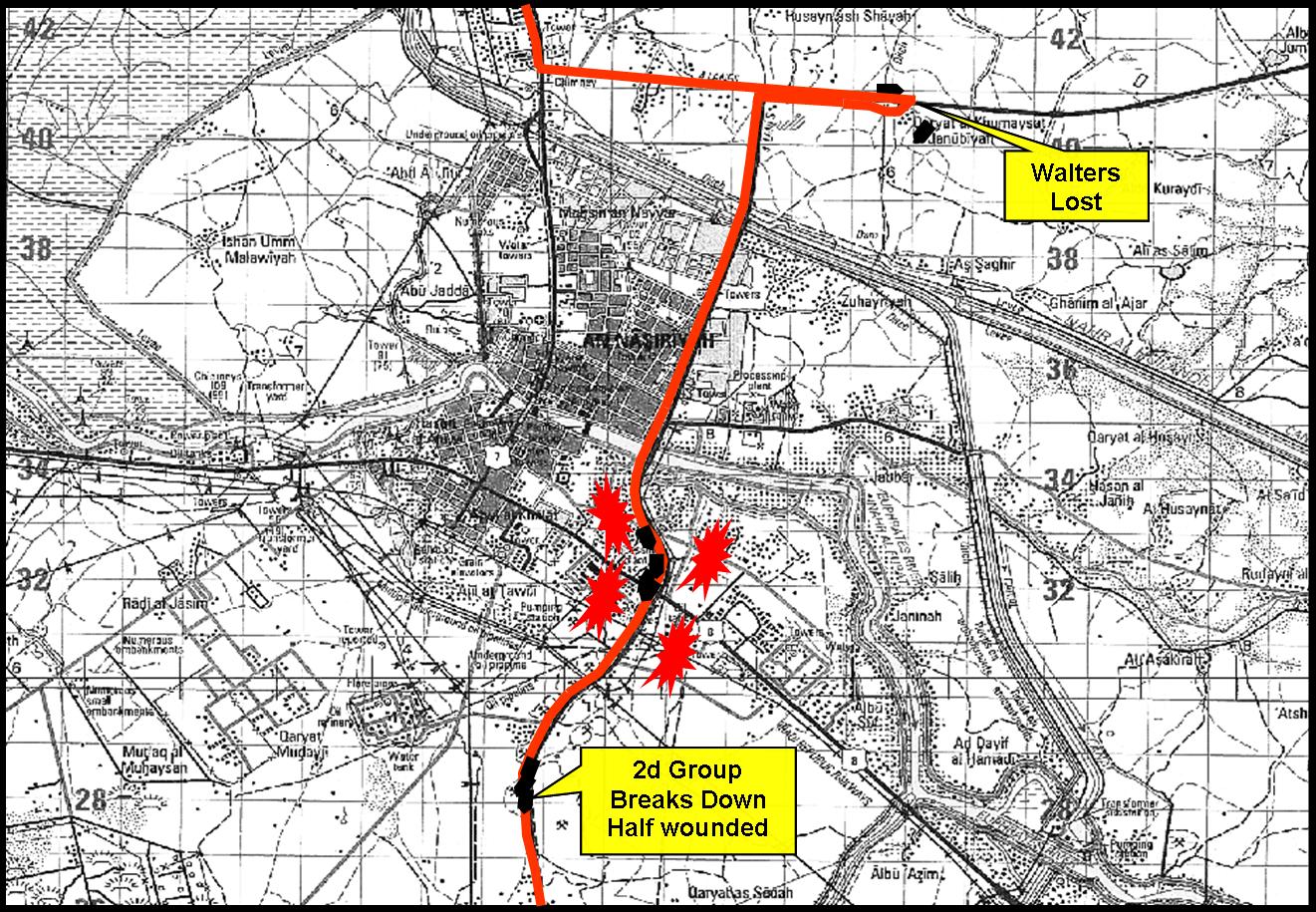
Before sunrise on the 23rd on March 2003, thirty-three
soldiers, traveling in eighteen trucks, stumbled into the dusty
desert city of An Nasiriyah. It wasn't until they had driven all
the way through the city that they realized that they were hopelessly
lost. As soon as they turned around and tried to retrace their path,
every Iraqi with a gun started shooting at the beleaguered convoy.
The lead three vehicles managed to run the gauntlet and get back
to the U.S. Marines' front lines.
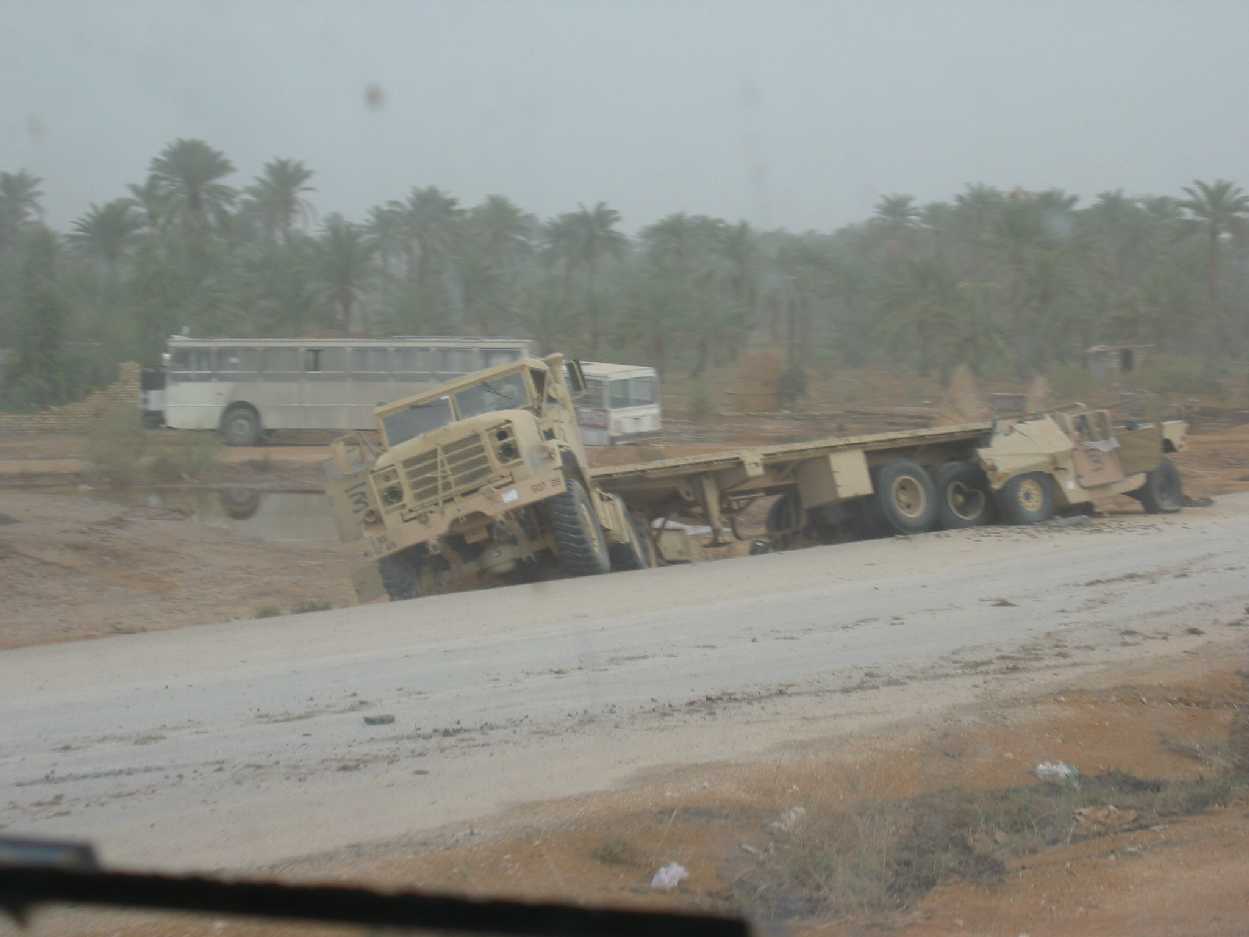
The next five vehicles broke down and ten soldiers
scrambled for cover in a nearby ditch. Surrounded, they each vowed
to go down fighting. They had fought to hold off the enemy for nearly
an hour, when Major Bill Peeples and the Marine tankers of Alpha
Company, 8th Tanks arrived to save the day. The Marines beat back
the enemy and rushed the ten soldiers to safety.
The remaining seventeen soldiers were not so fortunate.
Eleven were killed and six captured. Specialists Jamaal Addison
and James Kiehl both died when their vehicle careened through an
intersection and rolled over on its top. Private First Class Howard
Johnson II and Private Ruben Estrella-Soto's truck crashed at the
same intersection. Sergeant Donald Walters was lost north of An
Nasiriyah when his vehicle broke down. He leapt from his disabled
vehicle and laid down covering fire so that the rest of his unit
could turn their vehicles and get out of a horrific ambush. Private
Brandon Sloan was shot and killed while the vehicle he was in was
racing south. Chief Warrant Officer Johnny Mata's truck shuddered
to a stop atop a railroad overpass and burst into flames. Mata was
killed, but his driver, Specialist Hudson, survived.

507th Maintenance Company Ambushed at Dawn
Near the end to the doomed convoy, First Sergeant Robert Dowdy tried
to shepherd his soldiers to safety. Private First Class Lori Piestewa
was driving Dowdy's HMMWV. Specialist Edward Anguiano, Sergeant
George Buggs and Private First Class Jessica Lynch were riding in
the back. Piestewa managed to maneuver around obstacles and raced
all the way back through Nasiriyah. When the flatbed in front of
her jackknifed, Lori was unable to avoid the back of the skidding
truck. She plowed into the rear of the flatbed, instantly killing
Dowdy.
We know that Lori and Jessica survived the collision.
It is not clear what happened to Buggs and Anguiano. When Patrick
Miller approached the crash scene, he glanced in and thought everyone
was dead. Hudson, Hernandez, Lynch, Miller, Piestewa, Riley, and
Shoshana Johnson were all taken prisoner. Lynch and Piestewa were
separated from the others and eventually ended up in the Tykar Military
Hospital. Lori died while being treated, leaving Lynch alone and
near death.
The soldiers of the 507th Maintenance Company that
were killed that day were from all walks of life and every corner
of this nation. They were a swatch cut from the American fabric
and some of the first to die in this protracted war. Lori Piestewa
was an American Indian and single mother. Brandon Sloan and Robert
Dowdy were both from Cleveland Ohio. Brandon, 19, had left high
school early to join the Army, while Dowdy, 38, was a career soldier.
James Kiehl, 22, was a friendly computer technician who left behind
a pregnant wife. Buggs and Anguiano were not even members of the
507th. Dowdy had convinced them to take one of their vehicles in
tow two nights before. Their tow truck ran out of gas north of An
Nasiriyah and Dowdy, Piestewa and Lynch had picked them up.

Dowdy's HMMWV crashed into rear of Flatbed
By noon, the Marines were pressing north to secure
two vital bridges in An Nasiriyah. The fighting started long before
they reached the Euphrates River but it wasn't until they moved
into downtown Nasiriyah that all hell broke loose. Alpha Company
secured the Euphrates River Bridge while Bravo Company swung out
to the east side of town. Charlie Company raced over the Euphrates
River Bridge and charged through "Ambush Alley" to the
Saddam Canal Bridge.
Eighteen Marines died in Charlie Company's battle
for that northern bridge. Donald Cline was a twenty-one year old
husband and father of two young boys. Patrick Nixon loved history
and wanted to eventually be a teacher. Phillip Jordan was a career
Marine and loving husband and father. Fred Pokorney was a giant
of a man who had just been promoted to 1st Lieutenant. Sergeant
Michael Bitz was the father of two young boys and one-month old
twins. David Fribley and Brian Buesing were both Florida natives.
Fribley joind the Corps after 9/11 and Buesing had been in the Marines
since he graduated from high school. Brendon Reiss was the son of
a decorated Vietnam Veteran and Randal Rosacker was the son of a
Navy Master Chief submarine sailor. Jose Garibay and Jorge Gonzalez
were both from Southern California. Thomas Slocum was a 22 year
old from Colorado and Nolen Hutchings was from South Carolina. They
were both troubled teens that had worked to turn their lives around
in the Corps.
Tamario Burkett was a young Marine from upstate
New York. Kemaphoom Chanawongse was born in Thailand and came to
the United States at nine years old. He was the first to have a
Buddhist funeral at Arlington National Cemetery. Johnathan Gifford
wanted to be a Marine since he was a little boy. Michael Williams
joined the Corps late in life. At 31, he was just a Lance Corporal
but older than most of the young officers he worked for. On his
trip over to Iraq, he emailed his girlfriend and asked her to marry
him. Thomas Blair was not a member of Charlie Company. He was part
of an anti-aircraft unit that had been assigned to Charlie Company.
He too, went directly into the Marine Corps after high school graduation.
Twenty-nine lives ended too soon on that clear Sunday
in March. Twenty-nine families grieve to this day. These soldiers
and Marines died before there was a daily box score in America's
newspapers. They have been buried under 2000 more stories. Donald
Cline and Michael Williams died because they chose to help their
wounded comrades.
Many more soldiers and Marines would have died that day had it not
been for the Herculean efforts of men like, Private First Class
Patrick Miller, Sergeant Michael Bitz, Gunnery Sergeant Jason Doran,
Lieutenant Mike Seely, Captain Eric Garcia, and Major Bill Peeples.
These men are true American heroes.
Read about these brave young men and women in the
only book to tell the entire story of America's first major battle
in Operation Iraqi Freedom - "Marines in the Garden of Eden,"
Berkley, New York, will be released on June 6, 2006.
|